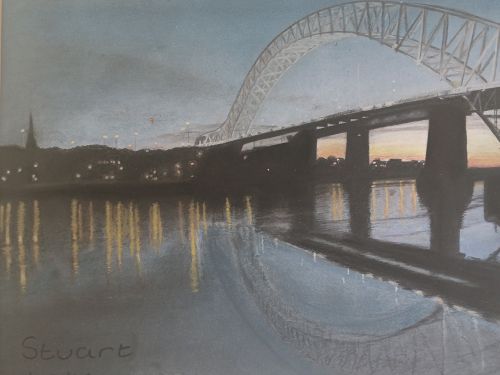
Runcorn Railway bridge and Runcorn Widnes Bridge
On the north side of the river, West Bank is a large sandstone outcropping which, accordin to the Romans resembles a wide nose. This is how the town of Widnes got its name. There are two separate bridges here at the Runcorn gap, where the River Mersey narrows quite consierably. The decks of both bridges are at the same level. It can sometimes be difficult to tell which parts of which bridge you are looking at. The picture shows them from the north side of the river. The separation between the bridges can be seen towards the far bank of the river, where the Manchester Ship canal runs adjacent. The Runcorn Widnes Bridge is closer, With the older Runcorn Rail Bridge to the right and behind, downstream of the newer bridge.
The rail bridge was built by the London and North Western Railway and opened in 1868. It carries the Liverpool branch of the West Coast Main line. It was contructed with an iron lattice box girder, sandstone pillars and huge brick arches along its approaches. The bridge has a walkway along the outside that long ago pedestrians could use to cross the river, with a toll both and a charge of 1 old penny or 1d. The walkway is still there but it has been closed and inaccessible for many years.
The rail bridge is also named the Britannia, or Aethelflaed bridge. Footings of a castle built by Aethelflaed were found during construction of the bridge on the Runcorn side of the river. There are battlements and crests on the bridge pillars to commemorate this. AEthelflaed ruled as lady of the Mercians from 911 until her death in 918. A time before England had been united to become a country. The river was the northern border of Mercia. This is why the river is named River Mersey.
The Runcorn Widnes Bridge is also known as the Silver Jubilee Bridge, or locally just as Runcorn Bridge. It was opened in 1961. It replaced the tranporter bridge, which was a platform that hung below steel cables and was pulled from one side to the other with its payload. The main span of the bridge is 330 meters. It is a through arch design made from riveted steel plates. The large gracefull arch is sometimes lit. The bridge was named the Silver Jubilee Bridge after works to change the carridgeway from two to four lanes was carried out between 1975 and 1977. As part of the work a new footpath was bolted to the side of the bridge, as there was no longer any room for pedestrians on the main deck. Both the Runcorn Rail Bridge and Runcorn Widnes Bridge cross the River Mersey and the Manchester Ship Canal.
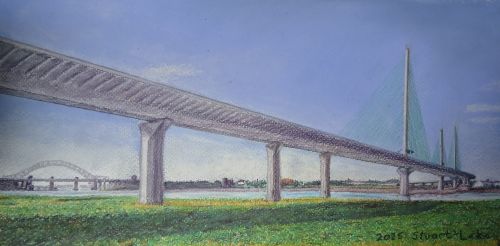
Mersey Gateway Bridge
The Mersey Gateway was opened in October 2017. With six lanes and mesuring 2.2 kilometers long, our newest bridge over the River Mersey is quite some size. It was an interesting project to behold. Constucted from reinforced concrete, the main part of the bridge over the river was poured in situ using walking forms. As the comcrete set the forms or moulds would be released and moved up or along and reinforcing steel would be installed ready for the next pour. The foundations for the towers in the river were poured in cofferdams. A temporary trestle bridge was erected to transport materials to the three towers and their cofferdams in the river. The bridge slowly stretched up and out from each of the 3 until it was able to met in the middle in-between each one and join up with the bridge approaches, which were mostly built in a similar way utilising much larger walking forms. The towers are different heights so the engineers building the bridge could take advantage of the most stable areas of bedrock to support the foundations for each pillar. The Mersey Gateway Bridge crosses the Sankey St Helens Canal in Widnes, the River Mersey and the flood plains either side of the river. On the Runcorn side Wigg Island, the Manchester Ship Canal, Astmoor Industrial Estate and the Bridgewater Canal. The picture shows the Mersey Gateway crossing the soutern flood plane and the River Mersey, continuing over to Widnes north of the river. As seen from Wigg Island in Runcorn. The Runcorn Widnes Bridge and Runcorn Rail Bridge can be seen downstream to the left.
Manchester Ship Canal
Built mostly by hand between 1887 and 1893 the 36 mile canal was a huge engineering project. It was the worlds largest navigation canal when it was completed. It also has the worlds only swing aquaduct at Barton, allowing the Bridgewater Canal to cross. It lifts vessels 60 feet on the way to Manchester through its locks. According to Peel Ports Group, who operate the canal it transports over 7.5 million tonnes of cargo each year.